The supply chain industry is undergoing a seismic shift, driven by Agentic AI and API-based connectivity. Unlike static automation, which operates within rigid boundaries, Agentic AI enables systems to reason, adapt, and act autonomously, transforming compliance, visibility, and workflow optimization. At the core of this revolution lies a critical enabler: APIs, which connect AI agents to real-time enterprise data, turning passive intelligence into active autonomy.
As Andrej Karpathy, former Senior Director of AI at Tesla, noted, we’re in the third generation of software, where natural language trains neural networks, making everyone a programmer. This shift empowers AI agents to interact with supply chain systems through conversational interfaces, replacing complex UIs and SQL queries.
How APIs Enable AI-Driven Supply Chains
Agentic AI operates through three layers: models, tools, and knowledge. Models, like GPT-5.0 or Claude, act as the brain, processing language and making decisions. Tools, primarily APIs, connect these models to external systems, such as ERP, WMS, or EDI platforms, enabling actions like retrieving shipment statuses or validating purchase orders. Knowledge—domain-specific data like SLAs, workflows, and master data—ensures AI agents make informed decisions tailored to your business.
For example, a user can say, “Show all delayed shipments exceeding SLA,” and an AI agent translates this into API calls, fetching and analyzing data across systems to deliver actionable insights instantly. This conversational UI, blending text or voice with traditional interfaces, is redefining how we interact with supply chain software.
Real-World Impact of AI and APIs
The partnership between Agentic AI and APIs is already delivering transformative results in supply chain management:
Automated SLA Tracking: AI agents monitor event chains and detect non-compliance in real time.
AI-Assisted Data Mapping: Intelligent systems learn from existing data structures and recommend accurate field mappings.
Predictive Testing: Before go-live, AI can simulate B2B transactions, identify potential integration issues, and reduce rollout risks.
Each of these capabilities is possible only when an enterprise platform is open, connected, and API-driven.
Zenbridge- Building the API Core for AI-Ready Supply Chains
At Zenbridge, our mission is to bridge the gap between traditional EDI and the intelligent future of supply chain management. By transforming EDI specifications into modern APIs, we create an environment where AI agents can interact seamlessly with transactional data without manual dependencies.
This API-first infrastructure lays the groundwork for the next generation of intelligent integrations, where compliance validation, partner onboarding, and event monitoring can be managed by autonomous digital agents.
The Intelligent Supply Chain Starts Now
The future of supply chain integration lies in AI agents orchestrating operations through APIs. As conversational decision-making systems replace complex interfaces, the ability to act autonomously depends on connected, API-driven architectures. Zenbridge’s platform provides that connectivity, making supply chains intelligent, adaptive, and self-sufficient.
What’s holding back your supply chain from AI-driven autonomy? Discover how Zenbridge’s API-first platform can transform your operations.
Introduction: Agentic AI Transforms EDI and Logistics Workflows
Agentic AI is redefining how modern supply chains operate by turning traditional EDI and logistics processes into intelligent, self-learning systems. With the advancements described in our white paper, “Promise to Practice: Agentic AI in Supply Chain (2025–2026),” AI is moving from being a mere automation tool to an autonomous decision-maker.
For EDI-driven industries, this shift means Natural Language is becoming the new interface, replacing complex UI and SQL queries. Agents are capable of analyzing vast data, making decisions, and orchestrating transactions in real time delivering the unprecedented reliability the supply chain has long needed.
Let’s explore five high-impact, real-world applications where Agentic AI is moving from promise to practice in EDI and logistics operations.
The traditional Order-to-Cash (O2C) process is fragmented, often requiring manual checks across ERP, WMS, and finance systems.
Agentic AI enables seamless, end-to-end automation of the O2C cycle by intelligently handling cross-system orchestration. AI agents utilize Tools to access APIs for order validation, inventory checks, shipment scheduling, and invoicing across modules. They learn from historical transaction patterns, predict exceptions before they occur, and trigger actions autonomously to ensure timely order fulfillment. This capability transforms O2C from a reactive workflow into a proactive, adaptive system, drastically improving operational speed and accuracy.
2. Accelerated Integration: Real-Time Partner Onboarding via Auto-Mapping
EDI mapping has been a decades-old bottleneck, often consuming weeks or months to onboard a new trading partner.
Agentic AI solves this by automating cross-system mappings. Leveraging knowledge (like a data field dictionary) and learned patterns from existing integrations, AI agents can auto-create new EDI mapping specifications. They auto-detect a new partner’s EDI requirements, validate connections, and configure the necessary workflows in minutes—not weeks. This capability accelerates business relationship deployment and ensures data accuracy from day one, transforming the tedious process of partner onboarding into a nearly real-time function.
3. Dynamic Decision-Making: Adaptive Routing for Freight Optimization
In logistics, achieving optimal efficiency requires constant, dynamic adaptation to disruptions.
AI agents continuously analyze real-time factors—such as route congestion, carrier performance, fuel prices, and delivery deadlines—fusing data from multiple modules. Using their Models for goal-driven reasoning, they dynamically reroute shipments mid-transit or re-tender loads without human intervention. This multi-module context capability allows agents to not only predict delays but also take immediate, optimal corrective action, significantly reducing transportation costs and improving customer satisfaction through reliable ETAs.
4. Compliance & Accuracy: Smart Document Generation and Processing
Ensuring that transactions adhere to complex business rules and SLAs across a chain of events is critical, yet historically reliant on manual audit.
A key practical application of Agentic AI is the reimagining of compliance monitoring. Business users can define business rule validations and SLA compliance in plain English. The agent converts these into structured outputs and, using its Tools, monitors event chains across different modules. For example, the agent can verify that all SKUs in a Purchase Order EDI are correctly reflected in the Shipment Notification EDI and the final Invoice, ensuring event-chain monitoring and flagging any discrepancy immediately for autonomous remediation.
5. Proactive Visibility: Predictive Exception Management and SLA Compliance.
The best exception management is predictive, not reactive.
Instead of waiting for a shipment to be late or an invoice to fail matching, Agentic AI continuously scans all transaction data for anomalies. By applying predictive logic, agents can identify potential order mismatches, delayed shipments, or failed compliance checks before they escalate into service failures. This capability aligns with the white paper’s vision of AI-generated supply chain simulations by generating and testing scenarios in real-time to maintain business continuity, ensuring your operation moves from managing exceptions to preventing them.
Conclusion: The Future of Autonomous Supply Chain Ecosystems
These are pivotal times, marking a shift toward human-friendly software ecosystems where users converse with systems rather than clicking through them. Agentic AI is not just the next step in automation; it is the realization of the autonomous, predictive supply chain.
The convergence of AI agents, natural language interfaces, and advanced data integration is proving its credible value by enabling: conversational queries, SLA checks, automated mapping, and proactive risk mitigation. This redefines core platforms like ERP, WMS, TMS, and EDI, making them faster, more accurate, and autonomously user-friendly.
Dive deeper into Agentic AI’s impact on supply chains.
[Download our whitepaper “Promise to Practice: Agentic AI in Supply Chain (2025–2026)”]
In today’s volatile global economy, supply chains no longer have the luxury of reacting to disruptions; they must anticipate them. Traditional rule-based systems, once celebrated for automating repetitive workflows, now struggle to keep pace with the speed, and complexity of modern trade.
The next evolution of supply chain intelligence is here: Agentic AI. A new class of self-learning, autonomous systems that transform how data, decisions, and operations flow across enterprises.
The Limitations of Rule-Based Automation
For decades, supply chains have relied on rule-based automation to streamline routine processes such as order confirmations, shipment updates, and invoice matching. These systems followed predefined logic: “If X happens, then do Y.”
While effective in structured environments, they lacked flexibility when handling exceptions, dynamic supplier behaviors, or evolving compliance rules. When disruptions occurred like supplier delays or shipment reroutes, these systems could only escalate alerts for human intervention.
In essence, they were reactive, not intelligent. They executed commands without contextual understanding.As global supply networks expand and data volumes surge, the need for a more adaptive, self-driven, and proactive intelligence layer has become inevitable.
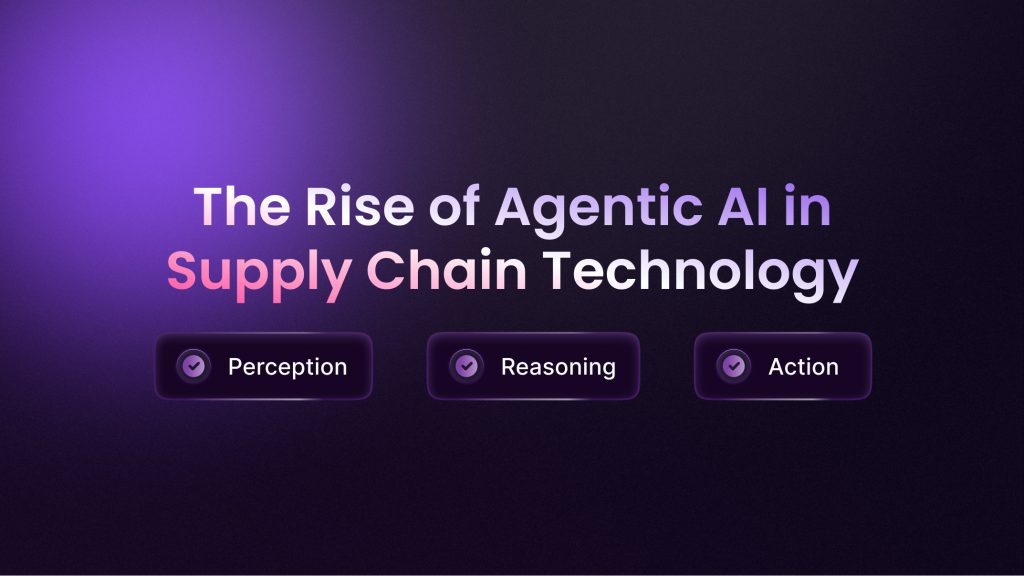
The Rise of Agentic AI in Supply Chain Technology
Agentic AI represents the next frontier of supply chain automation. Unlike traditional AI models that simply predict outcomes, Agentic AI systems act on those predictions autonomously.
These intelligent agents analyze vast, multi-source datasets in real time, identify potential risks or opportunities, and take corrective or optimizing actions without waiting for human prompts.
At its core, Agentic AI combines three critical capabilities:
Perception – Continuously interpreting real-time data from EDI transactions, ERPs, APIs, and partner networks.
Reasoning – Understanding business logic, constraints, and goals to make contextually relevant decisions.
Action – Executing workflows autonomously across systems – rerouting orders, alerting partners, or optimizing inventory allocation.
According to Gartner, by 2027, more than 60% of supply chain decisions will be made autonomously — marking a definitive shift toward self-learning ecosystems.
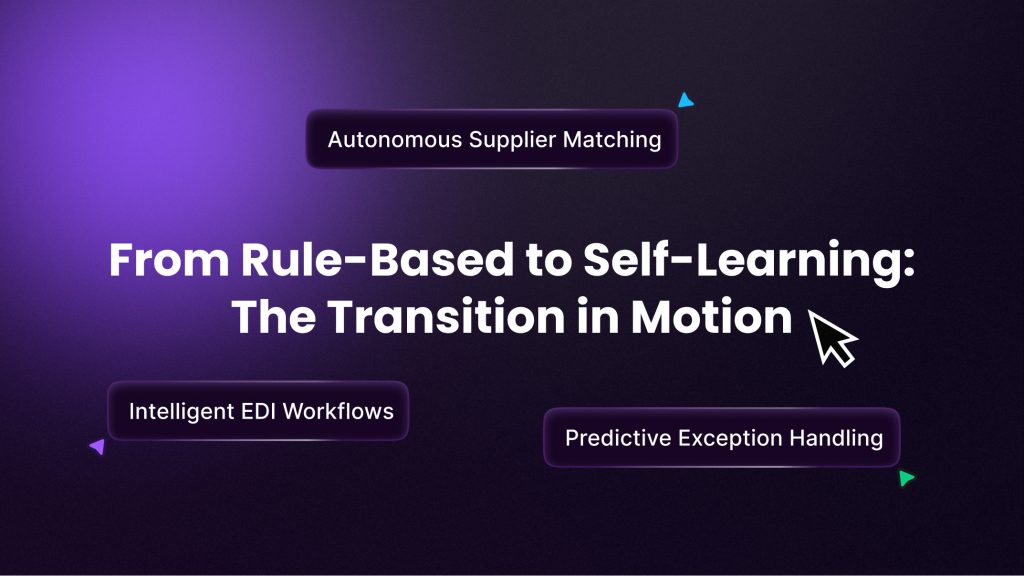
From Rule-Based to Self-Learning: The Transition in Motion
This transition from rule-based automation to agentic intelligence is already reshaping critical supply chain functions:
1. Intelligent EDI Workflows
Traditional EDI systems automate document exchange but depend heavily on manual rule updates.
With Agentic AI, EDI workflows become adaptive. For instance, when a partner’s EDI format changes, an intelligent agent can recognize the pattern, adjust the mapping, and validate the transaction automatically, eliminating downtime and human dependency.
Zenbridge’s Agentic EDI- as- API approach enables such dynamic learning, allowing systems to evolve in real time as trading ecosystems change.
2. Autonomous Supplier Matching
Supplier selection once relied on static catalogs and historical data. Agentic AI transforms this process by continuously evaluating supplier performance, lead times, pricing trends, and compliance history.
When a preferred supplier fails to meet capacity, the AI agent proactively recommends and even initiates engagement with alternative, high-performing suppliers that align with organizational KPIs.
This marks a powerful shift from data-driven insights to decision-driven actions.
3. Predictive Exception Handling
Traditional systems flag exceptions after they occur. Agentic AI predicts and prevents them.
For example, it can detect early signals of a shipment delay based on past carrier performance or regional disruptions, then autonomously trigger corrective actions such as rerouting goods, updating ETAs, or alerting customers.
This proactive exception handling minimizes operational friction, enhances customer satisfaction, and ensures continuity even amid uncertainty.
The Business Case for Autonomy
The payoff of autonomy isn’t just efficiency — it’s resilience.
Organizations adopting Agentic AI are not merely automating processes, they are architecting adaptive, self-correcting supply chains.
By enabling systems to learn, adapt, and act independently, enterprises achieve:
Faster decision cycles through continuous learning.
Reduced manual intervention and operational costs.
End-to-End visibility powered by real-time intelligence.
Enhanced partner collaboration through intelligent EDI-driven interactions.
Ultimately, Agentic AI transforms supply chains from being reactive ecosystems into autonomous value networks, where decisions are made at the speed of data.
Conclusion: The Autonomous Era is Here
The shift from reactive automation to autonomous intelligence is not a distant vision – it’s unfolding now.
As the backbone of digital trade, supply chains must evolve beyond static rule sets and embrace Agentic AI as the enabler of continuous learning, decision-making, and execution.
At Zenbridge, we are pioneering this evolution by embedding Agentic AI within our EDI- as- API platform, enabling supply chains to become truly self-learning, adaptive, and future-ready.
Because in tomorrow’s supply chain, autonomy isn’t optional – it’s inevitable.
Dive deeper into Agentic AI’s impact on supply chains.
Download our Whitepaper
Promise to Practice: Agentic AI in Supply Chain 2025–2026.
Picture a supply chain that instantly reroutes shipments to avoid delays or selects the best suppliers without human input. This is the reality of Agentic AI, a transformative technology that surpasses traditional AI and machine learning, bringing unmatched autonomy and flexibility to logistics and procurement.
As supply chains grow more complex, businesses need systems that don’t just analyze data but act on it independently. Agentic AI is creating intelligent, adaptive supply chains that are faster, smarter, and more resilient.
What is Agentic AI?
Agentic AI is the next evolution of artificial intelligence, designed to act with purpose and make context-aware decisions. Unlike traditional AI, which relies on fixed datasets and rigid rules, Agentic AI uses goal-driven agents that:
Process real-time data to anticipate challenges
Make decisions aligned with business objectives
Adapt strategies as conditions change
With advanced natural language capabilities, these agents enable supply chains to shift from manual coordination to proactive, autonomous operations, solving long-standing challenges like compliance and data integration.
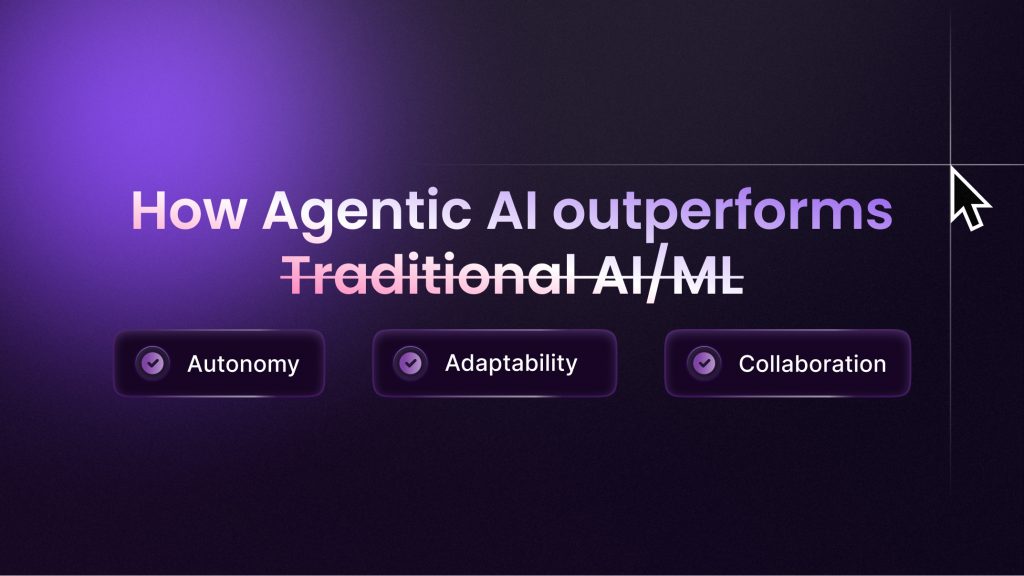
How Agentic AI outperforms Traditional AI/ML?
Traditional AI and machine learning excel at spotting patterns but falter when faced with unexpected disruptions, such as supply shortages or route changes. Agentic AI overcomes these limitations with three core strengths:
Autonomy – It independently manages processes and makes decisions without constant human oversight.
Adaptability – It learns and refines approaches based on new data and scenarios.
Collaboration – It integrates with other systems via APIs, forming a connected, decision-making network.
This shift from data-driven insights to decision-driven action allows Agentic AI to transform supply chains into self-regulating systems that thrive in dynamic environments.
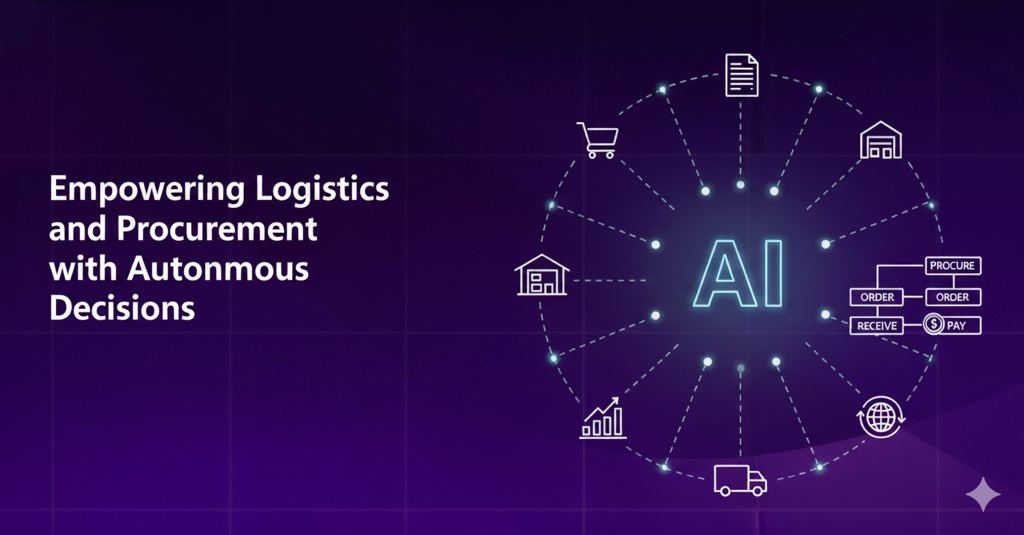
Empowering Logistics and Procurement with Autonomous Decisions
In supply chain operations, rapid and accurate decisions are critical. Agentic AI enables logistics and procurement systems to act independently in real time:
Logistics: Agentic AI monitors shipments, predicts disruptions, and optimizes routes instantly. For example, if a delivery is delayed, it can reassign carriers or notify partners without human intervention.
Procurement: It automates supplier selection, manages contracts, and assesses risks by analyzing market trends, ensuring decisions align with cost, compliance, and timelines.
By replacing static workflows into intelligent, self-learning systems, Agentic AI eliminates delays, reduces risks, and enhances agility across the supply chain.
Conclusion
Agentic AI is more than a technological leap, it’s the backbone of next-generation supply chains. By blending autonomy, adaptability, and seamless integration, it empowers businesses to move from reactive fixes to proactive solutions. From streamlining compliance to automating data mappings, Agentic AI is reshaping supply chain technology.
Dive deeper into Agentic AI’s impact on supply chains.
Download our whitepaper
Promise to Practice: Agentic AI in Supply Chain 2025–2026
Many businesses today are still relying on legacy, on-premises EDI systems that slow down operations, increase costs, and limit visibility. For example, one fast-growing manufacturer found that every compliance update required costly custom coding, while their ERP integration constantly broke down. By moving to a modern, cloud-based EDI platform, the company was able to run a pilot to automate key partner transactions, reducing manual work by 60% and cutting integration costs by nearly half. The result was faster partner onboarding, real-time ERP synchronization, and improved operational efficiency.
This guide provides a step-by-step roadmap for Legacy EDI Migration, helping businesses transition from outdated systems to modern, automated, and compliant cloud EDI solutions that scale effortlessly with growth.
Why Legacy Systems Are Holding You Back
Legacy EDI systems struggle with modern business demands due to several critical limitations:
1. Lack of Agility and Flexibility: These systems are rigid, use proprietary point-to-point connections, and require costly, specialized IT expertise. Making a simple change (like adding a new partner) can take weeks or months, halting business growth.
2. High Costs and IT Burden: Prohibitive initial and ongoing maintenance costs are driven by expensive, specialized hardware, on-premise infrastructure, and the need for rare skills (e.g., COBOL programmers).
3. Lack of Real-Time Visibility: They rely on batch processing, creating delays and a critical lack of real-time insight into orders, shipments, and inventory, making quick, informed decision-making impossible.
4. Security and Compliance Risks: Older systems often lack modern security protocols and struggle to keep up with rapidly evolving global regulatory requirements (like GDPR or e-invoicing mandates), leaving businesses vulnerable.
5. Integration and Data Silos: They are difficult to integrate with modern applications (ERP, CRM, cloud services), leading to data silos and forcing manual, error-prone data re-entry across systems.
6. Scalability Constraints: Legacy architecture wasn’t built for today’s massive transaction volumes. Scaling up is difficult and expensive, creating performance bottlenecks during seasonal peaks or rapid growth.
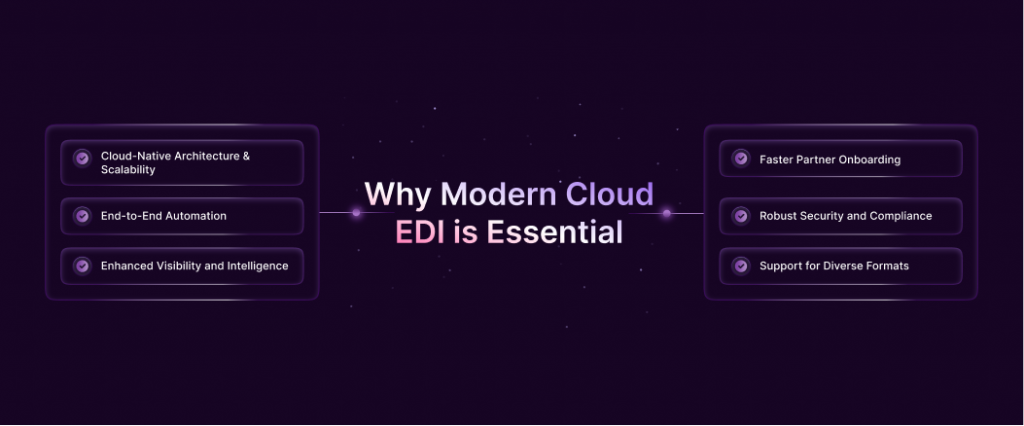
Why Modern Cloud EDI Is Essential
Modern EDI solutions (cloud-based and API-enabled) transform B2B communication from a rigid utility into a strategic business accelerator. They directly address every legacy shortcoming:
1. Cloud-Native Architecture & Scalability: Provides unprecedented flexibility, resilience, and elasticity. It enables real-time data exchange instead of batch processing and eliminates the need for expensive on-premise hardware, dramatically lowering IT overhead. EDI-as-API platforms like Zenbridge have handled over 100 + Million transactions, proving it can scale effortlessly.
2. End-to-End Automation: Automates the entire transaction lifecycle, from order receipt to invoicing. This eliminates manual data entry, drastically reducing human error (and costly chargebacks) and freeing up teams for strategic work. Case studies show that automation on modern platforms saves teams over 550+ hours of manual efforts annually.
3. Enhanced Visibility and Intelligence: Offers user-friendly dashboards and real-time monitoring of all transaction flows. This enables proactive error resolution and provides valuable business intelligence for supply chain optimization.
4. Faster Partner Onboarding: Modern platforms leverage reusable mapping libraries and centralized configuration to onboard new partners efficiently, often in days or weeks, directly supporting rapid market expansion. Platforms like Zenbridge can complete the full EDI integration (including testing) in as little as 2 to 3 weeks, compared to 3-9 months for legacy systems.
5. Robust Security and Compliance: Includes advanced security measures (like end-to-end encryption and audit trails) and is constantly updated to meet the latest global and industry-specific regulations automatically.
6. Support for Diverse Formats: Seamlessly handles traditional standards (X12, EDIFACT) alongside modern formats like XML, JSON, and APIs, ensuring compatibility with all partners regardless of their technological maturity.
The Migration Roadmap: Legacy to Modern
A successful migration requires a structured, phased approach to manage complexity and minimize disruption.
Phase A: Assessment and Discovery
The goal is to establish a clear baseline and define measurable objectives for the new system.
1. System Inventory & Audit: Document all current hardware, software, and database versions. Critically, document all customizations (proprietary data formats, custom code) and integration points with internal applications (ERP, WMS).
2. Performance and Pain Point Analysis: Quantify current performance by measuring transaction processing speeds, error rates, and downtime. Gather qualitative feedback from users on key pain points like costly maintenance and lack of visibility to justify the migration goals.
3. Trading Partner & Document Review: Compile a comprehensive list of all active trading partners, the specific EDI document types exchanged (e.g., 850, 810), and their required protocols (AS2, SFTP). Review all existing data maps to accurately estimate re-mapping effort for the new system.
Phase B: Platform Selection
Choose a modern EDI platform that acts as a strategic partner, not just a service provider.
1. Deployment & Scalability: Prioritize a cloud-native architecture that delivers automatic, elastic scaling for peak seasons without manual hardware upgrades or disruptive licensing changes. However, a hybrid model can serve as a practical interim step allowing businesses to retain certain systems or data on-premise until a full migration to the cloud is complete, especially useful when maintaining compliance with data residency regulations or managing highly customized legacy integrations during the transition.
2. Integration Capabilities: Look for platforms that offer real-time API integration and pre-built connectors for core applications (SAP, Oracle, NetSuite) to eliminate manual data entry and ensure reliable synchronization.
3. Standards & Compliance: The platform must support all major standards (X12, EDIFACT, JSON, XML) and deliver automatic compliance updates to manage evolving mandates like e-invoicing.
4. Visibility & Monitoring: Demand real-time dashboards that track every stage of documents (orders, invoices) and include proactive alerts to flag errors quickly before they disrupt the supply chain.
5. Support & Expertise: Choose a vendor with proven experience in legacy-to-modern transitions that offers dedicated support throughout the critical migration and post-go-live phases.
Phase C: Developing the Migration Plan (Go-Live Roadmap)
Break the transition into manageable steps with a focus on mitigating risk.
1. Data Preparation and Mapping: This is the most critical step. Meticulously convert legacy formats and custom code into the new system’s standardized formats. Validate all data migration using volume checks and reconciliation reports to ensure no loss or corruption of essential business data. During this phase, a hybrid setup where certain processes remain on-premise while others run in the new platform can help maintain operational continuity until full cloud migration is complete. Zenbridge EDI-as-API offers an unmatchable pricing model, with transaction fees as low as $0.05/transaction, providing immediate cost savings over traditional VANs and complex legacy licenses.
2. Testing and Validation: Set up a dedicated sandbox environment to mirror production. First, validate internal processes (EDI platform ↔ ERP). Then, extend testing to trading partners—starting with high-volume or complex ones—to confirm end-to-end functionality.
3. Risk Mitigation: Plan for potential risks like data loss or cutover downtime. Maintain verified data backups, set up contingency communication channels with key partners, and whenever possible, plan for parallel runs where old and new systems operate side-by-side before decommissioning the legacy infrastructure. A hybrid deployment can also act as a safety net during this stage, ensuring critical operations remain uninterrupted.
Phase D: Training and Change Management
A successful migration depends on people adopting the new system with confidence.
1. Internal Training: Provide hands-on sessions tailored to different departments: IT staff on configuration, and operations/supply chain teams on workflows, dashboards, and error monitoring. Highlight how automation solves long-standing pain points.
2. Partner Communication: Notify partners early about the transition timeline. Share essential details, testing schedules, and new communication protocols (e.g., moving from VAN to AS2). Provide clear onboarding guides or self-service portals to ease their transition.
3. Change Management Strategy: Appoint “EDI champions” in key departments to advocate for the system and channel feedback. Focus the narrative on the long-term value: automation, error reduction, and real-time data flow.
Monitoring and Optimization (Post Go-Live)
Cutover is the start of continuous improvement.
Establish Key Performance Indicators (KPIs) such as order-to-cash cycle time and error rates to validate migration success against legacy benchmarks. Clarify support responsibilities between your internal team and the vendor (e.g., Zenbridge support). Cloud-native solutions simplify this by having the vendor automatically manage updates, patches, and compliance changes. Commit to continuous improvement by using feedback to uncover opportunities for greater automation and staying current with emerging standards and technologies.
Conclusion and Call-to-Action
The journey from a slow, costly, and risk-prone legacy EDI system to a modern, cloud-native platform is a fundamental supply chain transformation. By following this structured roadmap from rigorous assessment and strategic selection to meticulous testing and robust change management your business can replace technical debt with an agile, real-time B2B integration layer. A modern solution eliminates manual errors, drastically cuts operational costs, and provides the real-time visibility and speed essential for future-proofing your business.
Zenbridgeis the modern, cloud-native platform designed to accelerate your migration with minimal disruption. We offer pre-built ERP connectors, rapid partner onboarding, and a dedicated team of experts to guide you through every step of the transition.
Book a Personalized Demo with Zenbridge Today See how easy it is to move your first trading partner and realize immediate cost savings.
You may have found yourself considering this question while searching for an API solution for EDI transactions. In today’s fast-paced supply chain environment, efficient B2B data exchange is essential, and EDI API software is leading the way.
In just a few decades, global data exchange in supply chains has increased a hundredfold, making delays and inaccuracies intolerable for a company’s growth. Effective data exchange relies on B2B integration APIs. Before you choose your integration software, it’s important to grasp the basics of EDI and API performance.
What is EDI?
Electronic Data Interchange (EDI) is a digital format for exchanging business documents, such as purchase orders and invoices. An EDI file contains crucial data organized in a standardized format, which is defined by industry standards like ANSI X12 and UN EDIFACT.
For instance, a purchase order EDI document includes the purchase order number, quantity ordered, products selected, and other relevant data points. Similarly, an Advance Shipment Notification (ASN) includes information regarding the shipment that is expected to arrive.
Before the advent of computers, these exchanges happened through paper documents and emails. However, for large-scale environments like retail, those methods are not scalable. This limitation led to the development of modern EDI solutions a few decades ago, which have now been further enhanced through EDI modernization with API technology.
What is an API?
APIs, or Application Programming Interfaces, enable software systems to interact with each other. This interaction typically occurs through a protocol known as HTTP, often utilizing REST API for Electronic Data Interchange (EDI). Essentially, a client system sends a request like a question to access specific information and the server system responds with the appropriate answer. This process allows two systems to exchange information seamlessly in today’s digital landscape, facilitating real-time data sharing.
For instance, this is how Facebook can access your current location. The app uses the API provided by your mobile operating system to retrieve this information, but only if you have granted the Facebook app permission to do so. Similarly, if you want to view your order history at Walmart, the company offers an API for supply chain integration that organizations can utilize for transactions.
Many industry leaders are shifting their operations to API-based EDI platforms because these systems can easily incorporate the latest technologies into their work environments. This signifies a move towards embracing EDI alternatives in 2025.
Technical differences between EDI and API
Let’s take a look a closer look at the technical differences between EDI and API:
EDI
API
Data container
File
HTTP request and HTTP response
Communication method
AS2, SFTP
HTTP, HTTPS
Data structure
ANSI X12, EDIFACT, VDA, or any other EDI standard commonly used
Designed by the API host.
Benefits of using EDI vs Benefits of using API
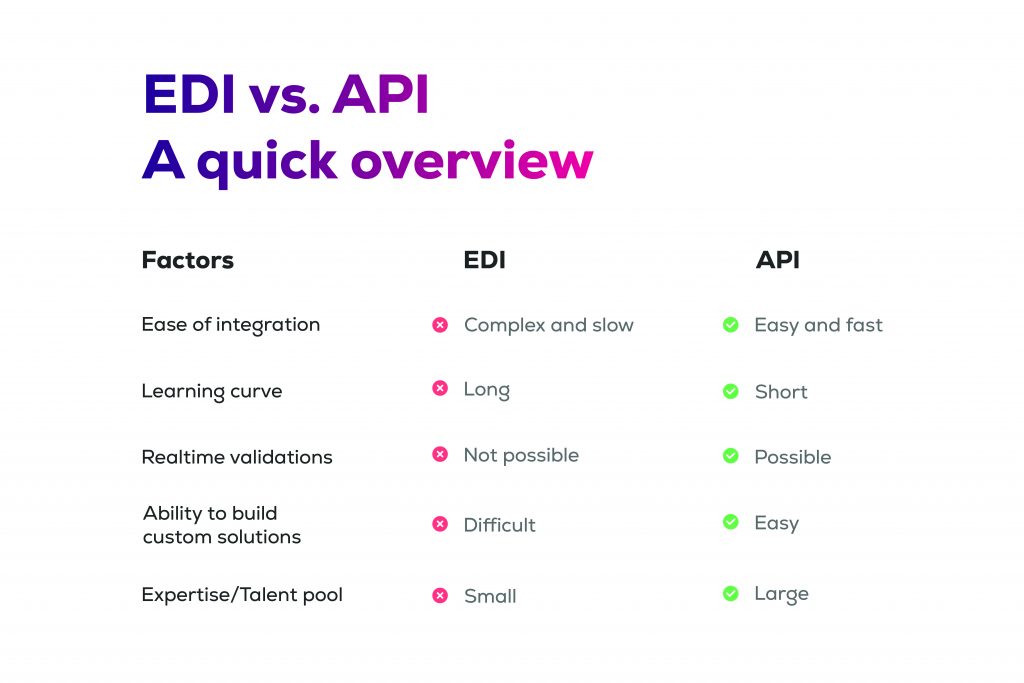
While both EDI and API serve their purpose for B2B integrations, there are significant differences that may be advantageous or disadvantageous depending on your existing B2B integration API infrastructure and the developer resources available within your organization, such as EDI developers versus API developers.
EDI
API
Hard
Easy
While you might get used to the structure of EDI standards if you are an EDI expert, for the average modern-day developer, hands down, API data structures such as JSON or XML are far easier to understand and deal with. Many businesses are now adopting an API for EDI transactions approach to simplify these integrations.
EDI data:
JSON data:
Ease of integration
EDI
API
Hard
Easy
The toolsets available for coding, testing, deploying, and maintaining B2B integration APIs in production are abundant. Cloud EDI API toolsets are much more advanced, mature, and user-friendly compared to traditional EDI software or platforms. Therefore, converting EDI to API in an ERP system has become a key focus for businesses.
Quality of data
EDI
API
Prone to bad data
High-quality data with real-time validation
Imagine applying for a visa and booking your tickets simultaneously, only to receive notification from the authorities days later, just before your journey, that your visa has been declined. This situation illustrates a major drawback of EDI today: the lack of real-time validation. EDI modernization through API addresses this challenge.
APIs enhance data accuracy and eliminate invalid data in real time. If you submit an invalid request, the API can validate your data against your trading partner’s requirements and reject it. This process helps eliminate bad data and chargebacks, showcasing the advantages of using APIs for EDI integration in retail.
Ease of automation
EDI
API
Hard
Easy
In today’s world, most modern systems, such as ERP, WMS, or financial software, interact through APIs. Integrating your systems with an API-based EDI platform ensures streamlined workflows. While it is possible to connect your EDI pipeline to other systems, doing so is complicated and often requires data transformations to convert EDI data into XML or JSON format, making end-to-end automation challenging.
Conversely, using APIs allows for seamless integration with external systems, enabling you to automate your entire workflow and facilitate real-time order processing more efficiently compared to EDI.
Availability of talent pool
EDI developers
API developers
Small and rare
Commonly available
According to Stack Overflow, the most readily available talent pool consists of API programmers. It is unrealistic to expect modern developers to learn traditional EDI methods unless there are compelling reasons to keep them engaged long-term. EDI developers are becoming increasingly scarce, and asking them to customize EDI processes beyond their regular integration tasks can create additional challenges. In contrast, there is a wealth of talent available for supply chain integration using APIs.
EDI vs API – Conclusion
EDI (Electronic Data Interchange) remains prevalent mainly because many large organizations have made significant investments in it over the years. These companies cannot simply abandon EDI without recovering their investments, which is understandable. Therefore, they should consider enhancing their EDI infrastructure by integrating APIs through an EDI as API hybrid model. This can be achieved by building an API layer on top of the existing EDI framework. Data from APIs can be converted into EDI format and sent through the existing EDI infrastructure, addressing challenges associated with transitioning to EDI as API.
There is a growing trend of cloud EDI as API software designed for today’s developers. Organizations like Amazon and Walmart are increasingly utilizing both API and EDI. While they have maintained EDI channels for years, they are now establishing parallel API channels for integrations as well. This trend is expected to continue due to the benefits outlined earlier.
Although it may seem diplomatic to balance both approaches, it is clear that for the average modern developer, using REST APIs for EDI integrations is significantly easier for B2B transactions. Is EDI still relevant in the API era? While EDI continues to thrive, there are indications that API could eventually replace EDI in modern B2B integrations. The shift towards innovative EDI solutions suggests a future increasingly dominated by API-based EDI platforms.
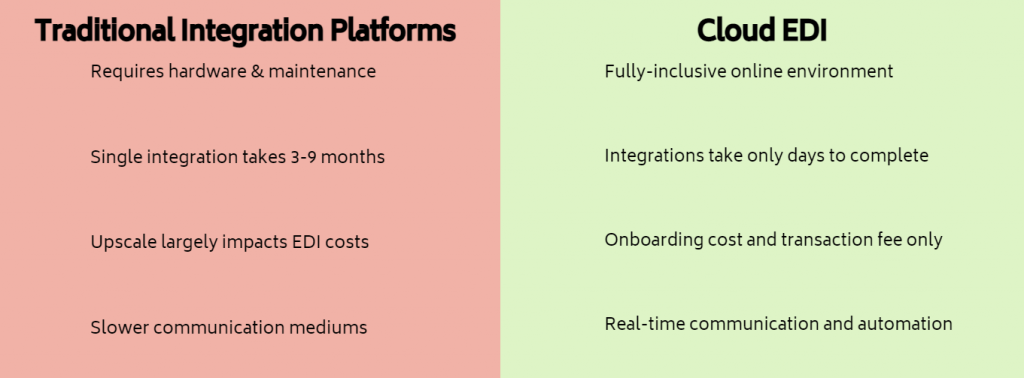
Cloud EDI is a modern, cloud-based approach to electronic data interchange that helps businesses send and receive documents securely over the internet. Unlike traditional EDI systems, which rely on offline workflows and expensive hardware, a cloud EDI platform enables faster, more flexible, and scalable integrations between trading partners.
With a robust cloud EDI solution, companies no longer need to maintain on-premise servers or manually handle every transaction. Instead, data exchange is streamlined, real-time, and highly automated – making cloud EDI software an ideal choice for small to mid-sized businesses looking to modernize their supply chain and B2B operations.
Cloud EDI and APIs
A cloud EDI platform typically works in combination with APIs, offering developers and non-technical teams access to dynamic and scalable EDI integrations. These APIs are far more advanced than traditional EDI systems and allow for rapid setup, validation, and exchange of EDI documents through the cloud.
For example, Zenbridge’s cloud EDI solution includes a powerful Spec Editor, reducing configuration time from days to hours using an interactive interface, without the need to learn legacy EDI coding.
Key Benefits of Using Cloud EDI Software for Your Business
Limitless Environment
A key advantage of any reliable cloud EDI software is its flexibility and scalability. Unlike traditional EDI platforms, which are limited by on-premise environments and hardware dependencies, a cloud-based EDI platform lets you scale integrations, automate data backups, and manage EDI documents without added infrastructure costs.
Faster Integrations
Modern Cloud-based APIs for EDI can deliver real-time responses for everything from specs configuration to production and error correction. Since the majority of the integration process on the API is automated, you save hundreds of manual hours wasted in coding, validations, and communication. Our API takes only days to integrate EDI with any trading partner worldwide. On the other hand, legacy EDI platforms still take 3-9 months to do the same.
Low Maintenance Cost
One of the most important benefits of adopting a cloud EDI solution is the significant reduction in infrastructure and maintenance costs. Many businesses still operate legacy EDI platforms that require in-house teams to manage servers, monitor activity, and maintain hardware. This includes paying expensive EDI specialists, 24/7 support staff, and investing in ongoing system upgrades.
With a cloud-based EDI system, all of this is handled by the platform provider. Zenbridge’s cloudEDI software manages its own infrastructure, including storage and uptime, reducing your overhead to just initial onboarding and a pay-per-transaction model. This makes it a highly cost-effective and scalable EDI solution for small and growing businesses.
Better Communication
Despite the availability of modern communication tools, many businesses using legacy EDI systems still rely on emails and spreadsheets for exchanging critical updates, leading to delays, miscommunication, and inefficiencies.
With Zenbridges’ interfunctional dashboard, communication is centralized and automated, allowing you to engage with your trading partners in real time. This is especially useful for real-time EDI integration, as it eliminates back-and-forth confusion and helps ensure all specifications are aligned before deployment.
Cloud-based systems also enable instant access from anywhere with an internet connection, supporting remote operations and faster decision-making, key aspects of a truly modern EDI integration strategy.
Conclusion
In today’s cloud-first world, businesses need a secure, scalable, and efficient way to manage EDI communications. A cloud EDI platform like Zenbridge not only simplifies EDI workflows but also eliminates the burden of infrastructure maintenance and manual configuration.
Whether you’re a small business or an enterprise, transitioning to a cloud EDI solution is essential to stay competitive in modern B2B commerce.
Explore how Zenbridge’scloud EDI software can transform your EDI operations – faster onboarding, lower costs, and real-time visibility, all from the cloud.
Managing a growing business comes with its challenges, especially when dealing with disconnected systems that don’t communicate effectively. What if you could not only bring all your essential business functions- like finances, customer relations, and supply chain management- into one reliable platform but also ensure they seamlessly exchange information with your trading partners?
Oracle NetSuite is designed to streamline operations, enhance transparency, and support business growth by simplifying internal processes. However, when it comes to external communication—such as sending purchase orders, invoices, and shipping details to trading partners—Electronic Data Interchange (EDI) becomes a game-changer. By integrating EDI with NetSuite, businesses can bridge the gap, automating the flow of critical data between NetSuite and trading partners. This powerful combination delivers end-to-end efficiency, reduces manual effort, and ensures unparalleled accuracy, enabling your business to operate like a well-oiled machine.
Why Choose Oracle NetSuite?
Oracle NetSuite, trusted by over 40,000 customers in more than 200 countries, is a leading cloud-based ERP solution designed to streamline operations, enhance transparency, and support business growth. While NetSuite simplifies internal processes, integrating Electronic Data Interchange (EDI) takes your operations to the next level by automating the exchange of critical business data, such as purchase orders, invoices, and shipping details.
Combining NetSuite’s ERP capabilities with an efficient EDI solution improves efficiency, eliminates manual tasks, and reduces errors, ensuring your business operates smoothly.
What is EDI, and Why Should it be Integrated with NetSuite?
Electronic Data Interchange (EDI) is a digital method for exchanging business documents—such as purchase orders, invoices, and shipping notices—between trading partners. It eliminates paper-based transactions, accelerates processes, and minimizes errors. Integrating EDI with NetSuite offers three key benefits:
Cost Savings: Automating manual processes reduces costs associated with supplies and labor, while minimizing errors that can lead to delays and inefficiencies. This results in better profit margins and streamlined operations.
Stronger Business Relationships: Accurate and timely data exchange improves communication with trading partners, fostering trust and collaboration. Strong relationships drive mutual success and enhance your reputation.
Streamlined Operations: Automating document exchange saves time, reduces errors, and provides real-time data, improving supply chain efficiency and enabling faster decision-making.
Industries Benefiting from NetSuite + EDI Integration
Various sectors are leveraging the power of NetSuite and EDI integration to enhance their operations, including:
Retail & E-Commerce: Automates order fulfillment and inventory management.
Manufacturing: Simplifies procurement, production, and distribution.
Logistics & Supply Chain: Streamlines shipment tracking and partner collaboration.
Healthcare: Ensures timely deliveries and compliance with regulations.
Food & Beverage: Enhances traceability and inventory management.
Regardless of the industry—whether retail, manufacturing, or healthcare—EDI integration with NetSuite can optimize operations, reduce manual tasks, and improve data accuracy.
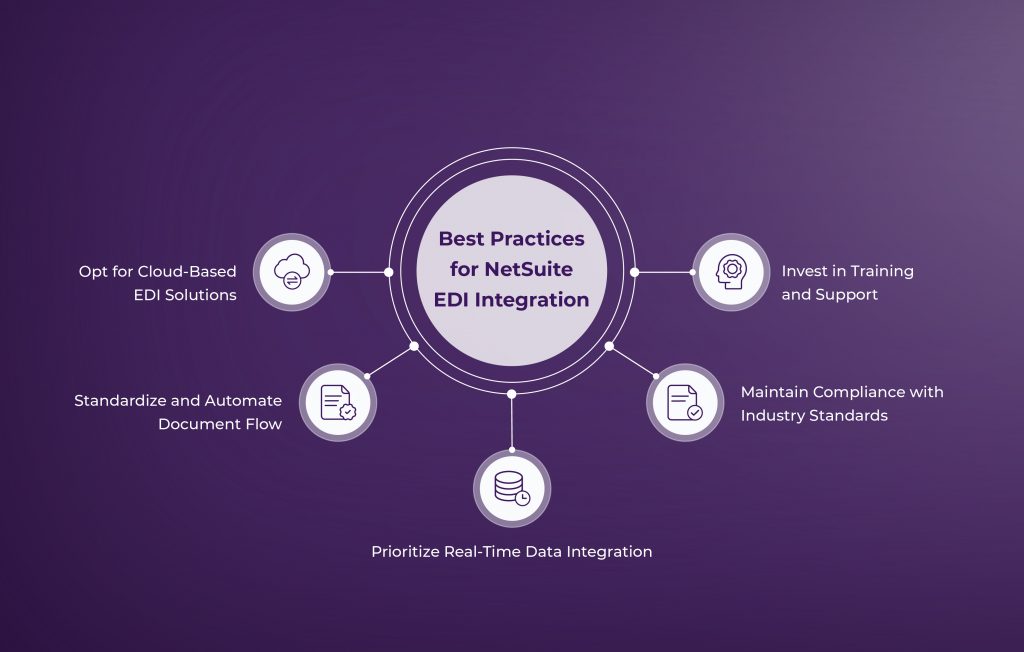
Best Practices for NetSuite EDI Integration
1. Opt for Cloud-Based EDI Solutions
Cloud-based solutions are scalable, cost-effective, and require minimal IT resources. They integrate seamlessly with NetSuite, enabling real-time access and flexibility.
2. Standardize and Automate Document Flow
Automating business documents, like purchase orders and invoices, eliminates manual data entry and ensures consistency among trading partners.
3. Prioritize Real-Time Data Integration
Real-time data exchange between NetSuite and trading partners supports quicker decision-making, improved order fulfillment, and enhanced operational visibility.
4. Maintain Compliance with Industry Standards
Ensure your EDI solution adheres to standards like X12, EDIFACT, or JSON to avoid data discrepancies and regulatory risks.
5. Invest in Training and Support
Equip your team with the necessary skills to manage and optimize the EDI system effectively. Select an EDI provider that offers ongoing support and training for smooth operations.
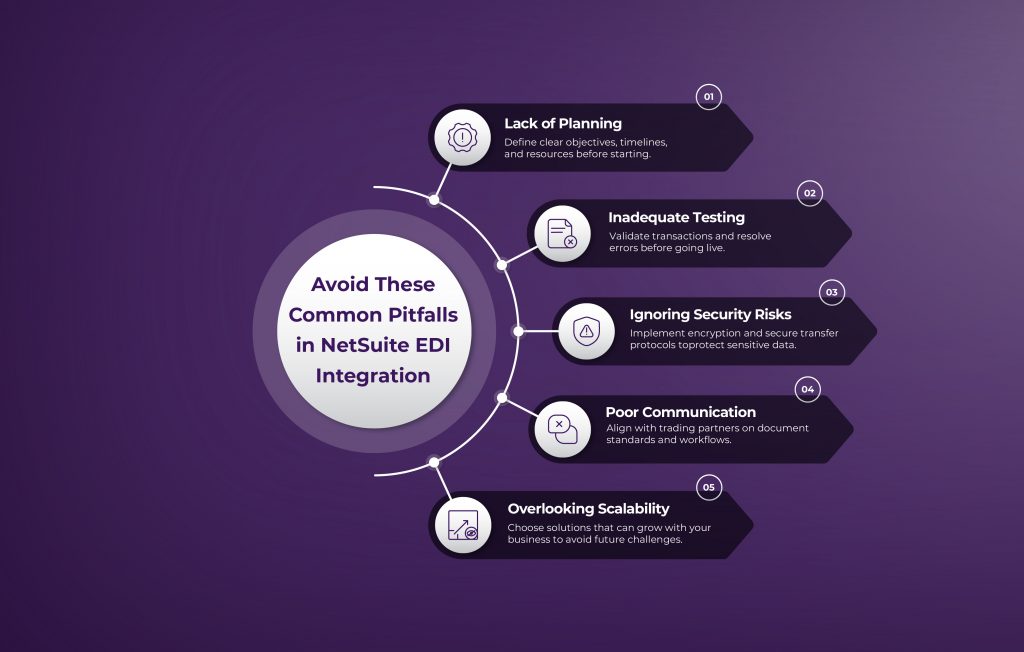
Avoid These Common Pitfalls in NetSuite EDI Integration
Lack of Planning: Define clear objectives, timelines, and resources before starting.
Inadequate Testing: Validate transactions and resolve errors before going live.
Ignoring Security Risks: Implement encryption and secure transfer protocols to protect sensitive data.
Poor Communication: Align with trading partners on document standards and workflows.
Overlooking Scalability: Choose solutions that can grow with your business to avoid future challenges.
By steering clear of these pitfalls, you can ensure a seamless and efficient integration process.
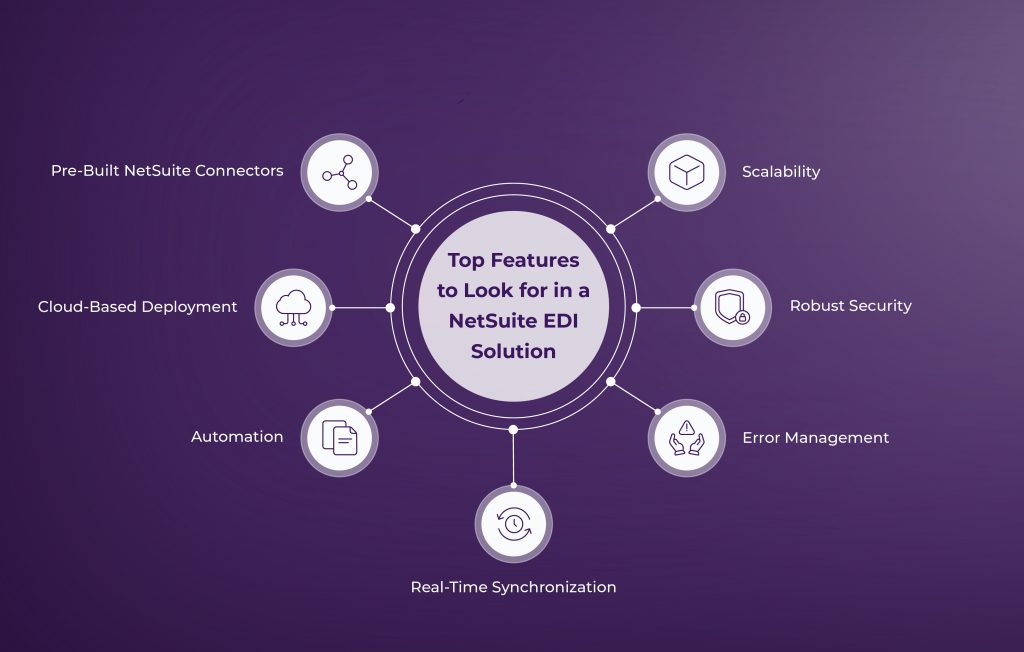
Top Features to Look for in a NetSuite EDI Solution
When selecting an EDI solution, consider features that ensure compatibility, efficiency, and scalability:
Pre-Built NetSuite Connectors: Simplify integration and reduce setup time.
Cloud-Based Deployment: Flexible, scalable, and low maintenance.
Automation: Streamline document exchange to save time and minimize errors.
Real-Time Synchronization: Update data instantly for faster decision-making.
Error Management: Automated alerts and tools for issue resolution.
Robust Security: Encryption and secure transfer protocols to safeguard data.
Scalability: Support for growing transaction volumes and additional trading partners.
How Zenbridge Simplifies NetSuite EDI Integration
Zenbridge offers a revolutionary approach to NetSuite EDI integration, providing speed, accuracy, and customization. Here are the key benefits:
1. Fastest Integration Time
Zenbridge’s pre-configured solutions enable businesses to integrate with NetSuite in less than two weeks, significantly accelerating time-to-value.
2. Real-Time Compliance Validation
Zenbridge ensures error-free data through real-time validation, saving you valuable time on manual corrections.
3. Automation of Core Workflows
Zenbridge automates essential processes such as order and inventory management, which enhances operational efficiency.
4. Dedicated NetSuite Experts
Every Zenbridge pricing plan includes access to a dedicated NetSuite expert, ensuring a smooth setup and ongoing support.
By prioritizing flexibility, speed, and expert guidance, Zenbridge helps businesses unlock the full potential of NetSuite EDI integration.
Conclusion
Integrating EDI with NetSuite is more than a technical upgrade—it’s a strategic move that drives efficiency, reduces costs, and strengthens business relationships. By adopting best practices, such as automation, real-time synchronization, and scalable solutions, businesses can ensure a smooth transition and maximize the benefits of this integration.
With 2025 on the horizon, there’s no better time to future-proof your operations. Zenbridge offers the expertise, innovation, and fast deployment you need to make NetSuite EDI integration a success.
Take the Next Step Discover how Zenbridge can revolutionize your EDI experience with NetSuite.
Schedule your demo with us today and empower your business to thrive in the fast-paced digital economy.
In 2025, Electronic Data Interchange (EDI) has become an essential tool for small and medium businesses (SMBs) looking to stay competitive in an increasingly digital and interconnected world. For SMBs, the ability to automate and streamline data exchange processes is no longer a luxury but a necessity.
However, traditional EDI systems often pose challenges for SMBs, such as high costs, complexity, and limited flexibility. Modern EDI solutions, tailored for SMBs, offer affordable, easy-to-use, and scalable alternatives, enabling businesses to achieve efficiency without the burden of legacy systems.
Importance of EDI for SMBs
In the transformative world of traditional EDIs, small businesses face the complexity of streamlining and managing their day-to-day operations. It is quintessential to have a systematic supply chain workflow for any Small/Medium Businesses. To avoid narrow bandwidth and low frequency in transacting data from one business to another, we need EDIs to standardize the business flow and ensure that the transactions happen at a higher frequency without any data corruption.
While traditional EDIs are verbose and ambiguous, modern EDI providers or EDI as API platforms help your business function seamlessly with a centralized e-commerce ecosystem boosting efficiency and visibility.
EDI is a transformative tool for SMBs, providing several critical advantages:
Automation and Efficiency: EDI automates the exchange of critical business documents, such as purchase orders and invoices, eliminating manual processes and reducing delays.
Error Reduction: EDI minimizes human errors by standardizing data exchanges, leading to more accurate transactions and improved partner relationships.
Scalability: As SMBs grow, EDI systems can scale to support increasing transaction volumes and additional trading partners.
Top EDI Solutions for SMBs in 2025
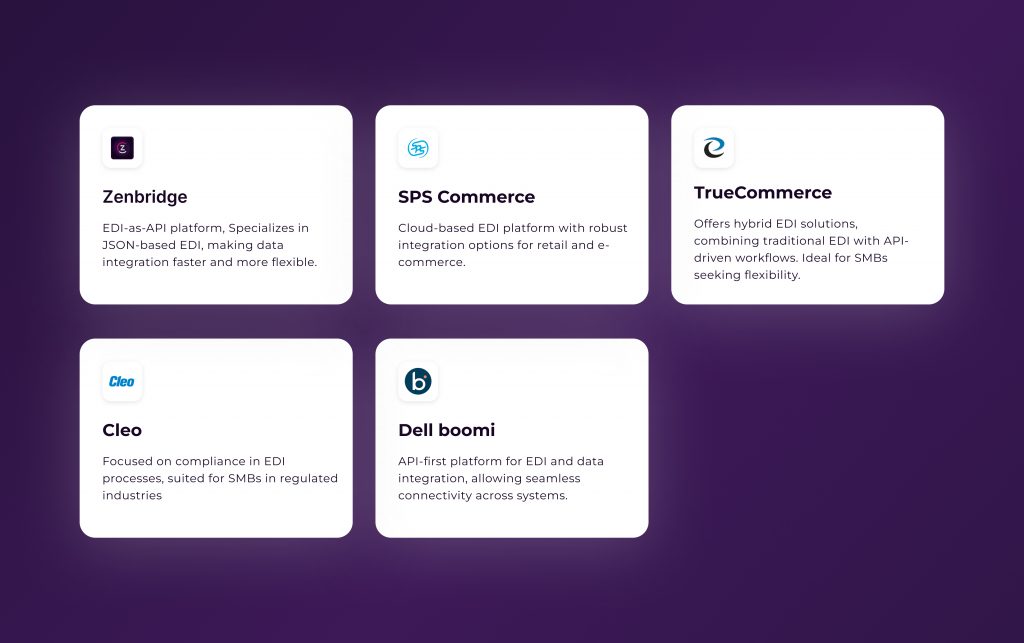
Here are the leading EDI platforms tailored for SMBs, offering innovative features and exceptional support:
1. Zenbridge
Specializes in JSON-based EDI, making data integration faster and more flexible.
Pre-built connectors for popular ERPs like Netsuite, Shopify etc.
Unlimited support to ensure smooth implementation.
Scalable, cloud-based solutions designed for growing businesses.
An extensive network of trading partners.
2. SPS Commerce
Cloud-based EDI platform with robust integration options for retail and e-commerce.
3. TrueCommerce
Offers hybrid EDI solutions, combining traditional EDI with API-driven workflows.
Ideal for SMBs seeking flexibility.
4. Cleo
Focused on compliance in EDI processes, suited for SMBs in regulated industries.
5. Dell Boomi
API-first platform for EDI and data integration, allowing seamless connectivity across systems.
Key Features SMBs Should Look for in a Modern EDI Solution
When selecting an EDI solution, SMBs should prioritize features that align with their unique needs:
Cost-Effectiveness: Solutions that offer affordable pricing models without compromising functionality.
Ease of Use: Platforms with intuitive interfaces that reduce the learning curve for teams.
Cloud-Based Solutions: Cloud-based EDI ensures accessibility, flexibility, and reduced infrastructure costs.
Integration Compatibility: Ability to integrate with commonly used SMB tools such as QuickBooks, Shopify, and NetSuite.
Support and Training: Comprehensive customer support and training resources for teams with limited technical expertise.
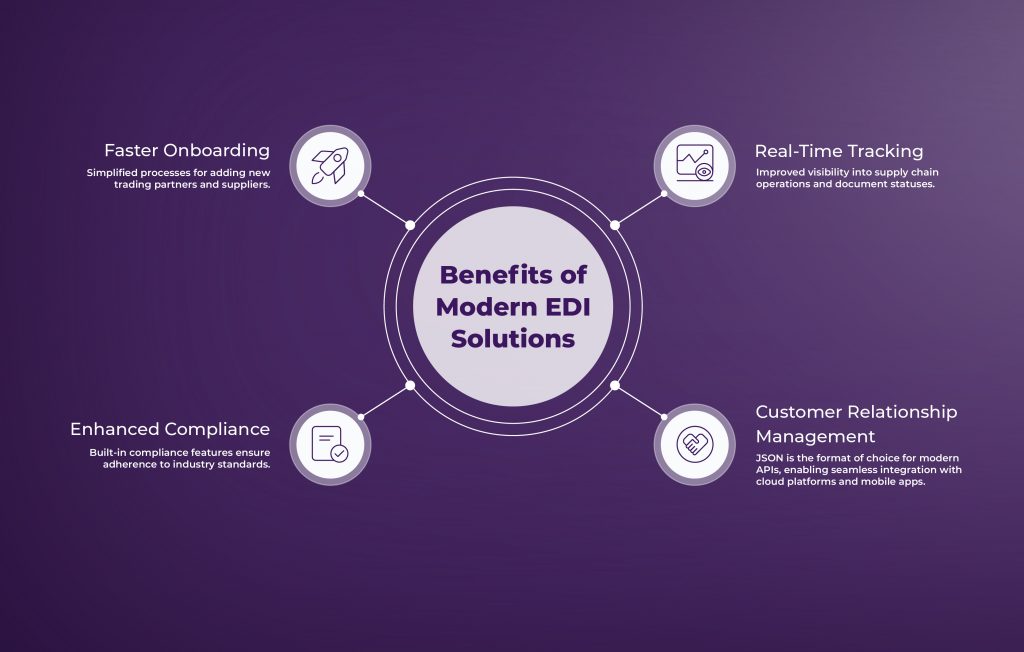
Benefits of Modern EDI Solutions
Modern EDI systems offer several advantages over traditional methods, particularly for SMBs:
Faster Onboarding: Simplified processes for adding new trading partners and suppliers.
Enhanced Compliance: Built-in compliance features ensure adherence to industry standards.
Real-Time Tracking: Improved visibility into supply chain operations and document statuses.
Customer Relationship Management: Efficient transactions lead to better customer satisfaction and loyalty.
Improved Productivity: Automated transactions lead to a smooth process of exchanging data.
Scalability: Adapts to the growing volume of EDI transactions resulting in fully managed operations. (Handles high volume of data without downtime errors with highly efficient systems that adapt to the growing volume of EDI transactions resulting in fully managed operations.)
Less Redundancy: Organized data storage to reduce the repetition of processes or documents.
Increased Accuracy: Effective data mapping with internal systems and EDI formats of incoming and outgoing data to maintain the sanctity throughout the EDI lifecycle.
Enhanced Visibility: Updated dashboard with each transaction uplifting the process transparency.
Streamlined Communication: Centralized channels to communicate without barriers via modern connection technologies
High Security: Protected network and routers for secure EDI transmission with regular evaluations to retain confidentiality.
Case Study/Success Story
Case Study: Zenbridge Empowering a Growing Retailer
A mid-sized retail company struggled with manual data entry and delayed transactions using a traditional EDI system. Switching to Zenbridge’s JSON-based EDI platform brought transformative results:
Reduced Errors: A 95% reduction in transaction errors.
Cost Savings: Saved 30% on annual EDI-related expenses.
Faster Transactions: Reduced order processing time from 48 hours to 12 hours.
The retailer now enjoys seamless scalability and better partner relationships.
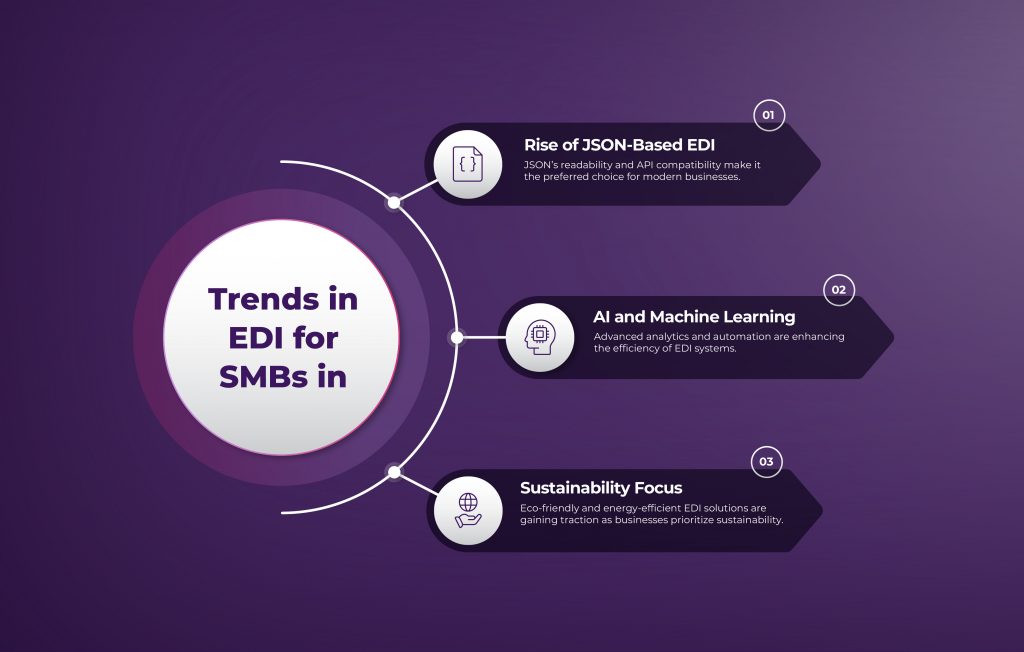
Trends in EDI for SMBs in 2025
Rise of JSON-Based EDI: JSON’s readability and API compatibility make it the preferred choice for modern businesses.
AI and Machine Learning: Advanced analytics and automation are enhancing the efficiency of EDI systems.
Sustainability Focus: Eco-friendly and energy-efficient EDI solutions are gaining traction as businesses prioritize sustainability.
Stand-Out Features of a Best EDI Provider
Zenbridge is redefining EDI for SMBs with its innovative approach and customer-centric features:
JSON-Based EDI: Simplifies data exchange with flexibility and speed.
Pre-Built Connectors: Seamless integration with tools like QuickBooks, Shopify, and NetSuite.
Unmatched Support: Unlimited training and customer support for non-technical teams.
Affordable Pricing: Scaled pricing models tailored to SMB budgets.
Conclusion
Choosing the right EDI solution can be a game-changer for SMBs in 2025. Modern platforms like Zenbridge empower businesses to embrace automation, reduce costs, and scale operations efficiently.
Take Action Today: Discover how cutting-edge EDI solutions can transform your business.
Schedule a demo with us to explore your options and future-proof your EDI processes.